
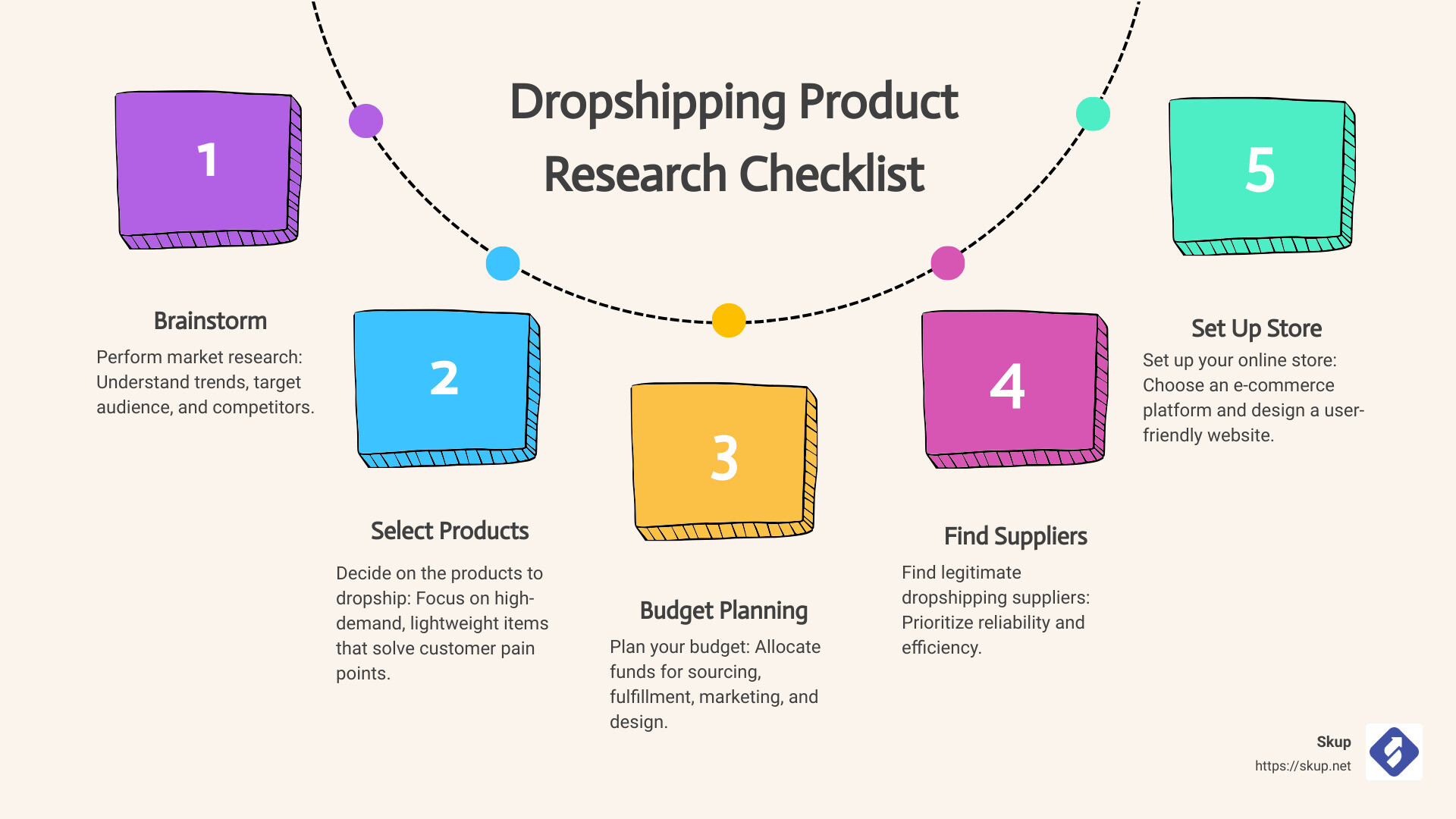
Starting a dropshipping business becomes easy when you follow a structured checklist instead of random steps. Most beginners fail because they jump between ideas—product research one day, store design the next, ads the next—without a clear sequence.
A real e-commerce setup follows a logical flow: foundation → product → store → marketing → testing → scaling. If you follow this order, you avoid confusion and reduce costly mistakes.
This guide gives you a complete step-by-step checklist from zero to launching your first profitable store.
Phase 1: Business Foundation Setup
Before building anything, you need clarity on your business direction.
Start by selecting a niche. A niche is the category your store will focus on. Strong niches include beauty, fitness, pets, home improvement, gadgets, and lifestyle products.
A good niche should have:
- consistent demand
- emotional or problem-solving products
- room for multiple products (not just one item)
Next, define your target audience. You need to understand:
- who your customers are
- what problems they face
- what motivates them to buy
Without audience clarity, marketing becomes random and inefficient.
Phase 2: Product Research and Validation
Product selection is the most important step in dropshipping.
You should not choose products randomly. Instead, use structured research methods.
Start by analyzing:
- TikTok trending products
- Facebook ad library
- AliExpress best sellers
- competitor stores
A winning product usually has:
- strong visual appeal
- clear problem-solving ability
- emotional or curiosity trigger
- proven engagement online
Before moving forward, validate the product by checking:
- competitor ads running consistently
- engagement on social media
- existing demand signals
If a product is not already showing traction, it is risky to launch.
Phase 3: Shopify Store Setup
Once the product is selected, build your store.
Start with Shopify and choose a clean, professional theme. Avoid overcomplicated designs.
Your store must include:
A homepage that clearly shows what you sell
A product page that explains benefits clearly
A simple checkout process
Trust elements like reviews and guarantees
Your product page should focus on:
- benefits, not technical features
- emotional appeal
- problem-solution storytelling
- clear visuals and videos
Confusing stores lose customers quickly.
Phase 4: Essential Apps Installation
After setting up your store, install essential apps.
You will need:
Product import and fulfillment tool (DSers, CJ Dropshipping, or Zendrop)
Email marketing tool (Klaviyo or Omnisend)
Review system (Judge.me or Loox)
Popup tool (Privy or similar)
These tools improve automation, trust, and conversions.
Keep your app stack minimal at the start to avoid slowing down your store.
Phase 5: Marketing Preparation
Before running ads, prepare your marketing assets.
Create:
- product videos
- short-form TikTok-style content
- ad creatives with hooks
- product demonstration visuals
Your goal is not perfection but attention-grabbing content.
A strong ad creative should include:
- a hook in the first 3 seconds
- a relatable problem
- product demonstration
- clear result or benefit
You should prepare multiple variations for testing.
Phase 6: Launching Paid Ads
Start with small testing campaigns.
Do not scale immediately. Your goal is to collect data.
Run multiple ad variations:
- different hooks
- different angles
- different audiences
Track key metrics:
- CTR (click-through rate)
- CPC (cost per click)
- conversions
- ROAS (return on ad spend)
Let the data decide the winning direction.
Remove weak ads quickly and focus on strong performers.
Phase 7: Optimization and First Sales
Once you get traffic, focus on conversion optimization.
Improve:
- product page clarity
- trust signals
- checkout flow
- pricing presentation
Even small changes can significantly improve conversion rates.
At this stage, your goal is to reach consistent first sales and identify winning patterns.
Phase 8: Scaling the Store
After finding a winning product, begin scaling.
There are three main scaling methods:
Increase budget on winning ads (vertical scaling)
Create new ad variations (creative scaling)
Expand into new audiences (horizontal scaling)
Scaling should be gradual, not aggressive.
Monitor performance carefully during expansion.
Phase 9: Automation Setup
Once sales become consistent, start automating operations.
Automate:
- order fulfillment
- email sequences
- abandoned cart recovery
- customer support responses
Automation helps you manage more orders without increasing workload.
This is where your store starts becoming a system instead of manual work.
Phase 10: Long-Term Growth Strategy
After stability, focus on long-term branding.
Expand by:
- adding new related products
- building email marketing funnels
- growing organic TikTok content
- improving SEO traffic
At this stage, your business becomes less dependent on ads and more on brand value.
Final Thoughts
Dropshipping success is not random. It follows a clear step-by-step structure.
If you follow the correct sequence—niche → product → store → ads → optimization → scaling—you eliminate most beginner mistakes.
The key is execution discipline. Not skipping steps. Not rushing scaling. Not guessing products.
A structured approach always beats a random approach in e-commerce.
FAQ (Frequently Asked Questions)
1. Can I start dropshipping without experience?
Yes, but you must follow a structured checklist instead of guessing steps.
2. What is the most important stage?
Product research and validation is the most critical step.
3. How much budget do I need to start?
You can start small, but you need enough for testing ads and store setup.
4. How long before I get sales?
It depends on testing and optimization, but first sales usually come during the testing phase.
5. Do I need automation from day one?
No, but you should add automation once you start getting consistent orders.